The goal of this presentation is to provide teachers with resources to help their grade 7 and 8 students understand the risks of cannabis use and encourage them to pursue activities that can help them feel their best. The first part of the experience educates participants about the effects of cannabis use on their brain and mental health. Then, the second part provides youth with alternative activities that produce similar chemical reactions in the brain but in a healthier way.
By encouraging participation in engaging experiences that tap into physical activity, music and art, the lesson aims to spark a passion for an activity that is more beneficial to overall mental and physical health.
This page provides you with tips and tools to host your own Pursue Your Passion lesson. Through the materials provided, you can help increase awareness of the risks associated with cannabis use, particularly to mental health.
Engaging youth
This program provides you with everything you need to build your own Pursue Your Passion lesson, including a slideshow, speaking notes and additional resources. The materials have been created to help you deliver fact-based information, thought-provoking activities and tools to help your students make healthy choices.
Here are some tips to help you engage with your students in a way that promotes open and positive communication:
Active listening: Ask open-ended questions, encourage discussion and let them know you hear them.
Get in the right frame of mind: Understand their perspective.
Location: This program can easily be done from your regular classroom. For home learning, students should find an area in their home where they are comfortable.
Technical requirements: You will need internet access and a projector or large monitor to share the module content for the class.
Students with access to individual computer, tablet or mobile devices will be able to engage with the interactive content on their own screens.
Additional resources
Are your students interested in continuing the conversation on cannabis? Please share these resources with your students and their parents or guardians for more information:
The compounds in cannabis affect the same systems involved in brain development. Through the Pursue Your Passion experience, participants learn the facts on how cannabis affects each area of the brain and what could potentially happen long term.
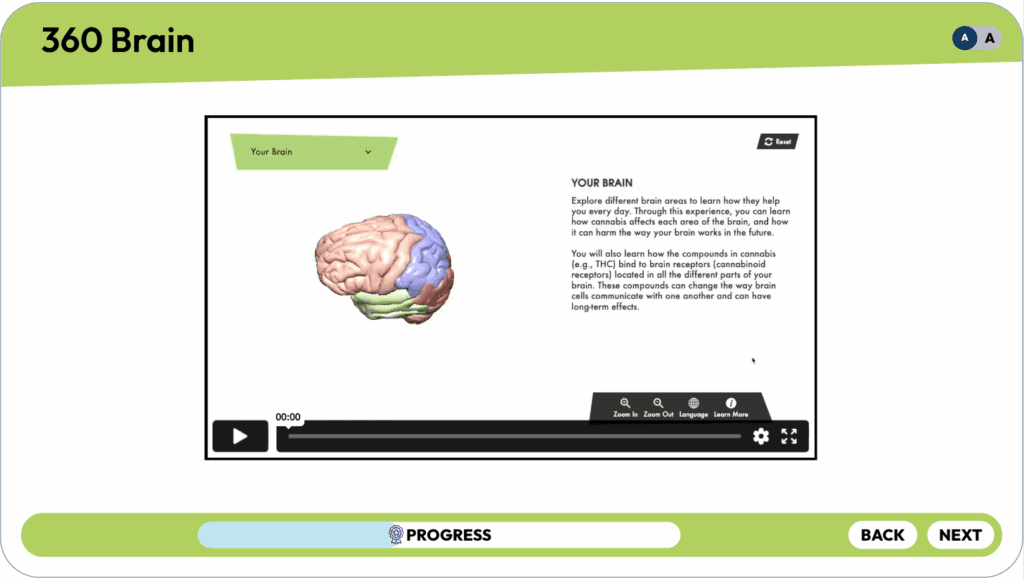
With the 360° Brain education tool, participants will be able to access different parts of the brain, find out what they do and learn about the impact of cannabis use. It is important to stress that frequent cannabis use can have a significant impact on adolescent brains.
Since the brain is still developing up to the age of 25, youth are especially vulnerable to the effects of cannabis on brain development and function.
We encourage you to familiarize yourself with the platform before your lesson. Focus on the areas of the brain that affect thinking, planning and decision-making.
Decide ahead of time if you plan to teaser the activity and make time in class at a later date or send an email home to encourage parents and guardians to explore the activity with their kids.
Pursue Your Passion lesson guide
Before getting started, please ensure you have the following:
The Pursue Your Passion slides are set up and visible to the students.
Students have access to a computer or tablet for interactive activities.
Teacher's notes legend
Directions are in green.
Post-module survey
Thank you for participating in Health Canada’s Pursue Your Passion teacher-led module. We hope you found the content and its delivery informative for your students.
We would love your feedback on the module! Please take a few minutes to fill out the Teacher Feedback Survey.
Health Canada also offers other programs on substance use, including:
Good [morning/afternoon]. Today we have a special presentation.
Teacher's Notes
Chapter 1: Overview and Pursue Your Passion
Teacher's Notes
Pursue Your Passion is a program developed by the Government of Canada to educate you about cannabis and its risks to your mental health and brain function.
It’s also about pursuing activities that can make you feel your best, without the potential health and safety risks of cannabis use.
Teacher's Notes
Did you know that Canadian and American teenagers use cannabis more frequently than any other teenagers in the world?
It’s important to know that teens and young adults who use cannabis are more likely to experience poor mental health, including long-term mental health problems such as substance use disorder (aka addiction), anxiety, depression and even schizophrenia in those who have a family history.
This is because cannabis interferes with healthy brain growth, which continues until around the age of 25.
Some teenagers may be struggling with mental health and use cannabis to cope. Though it may feel like cannabis is helping in the moment, using it daily, or near daily, can actually make you feel worse over time.
We’ll explore why this is later in the presentation.
Teacher's Notes
Let’s start with a pop quiz to gauge your knowledge:
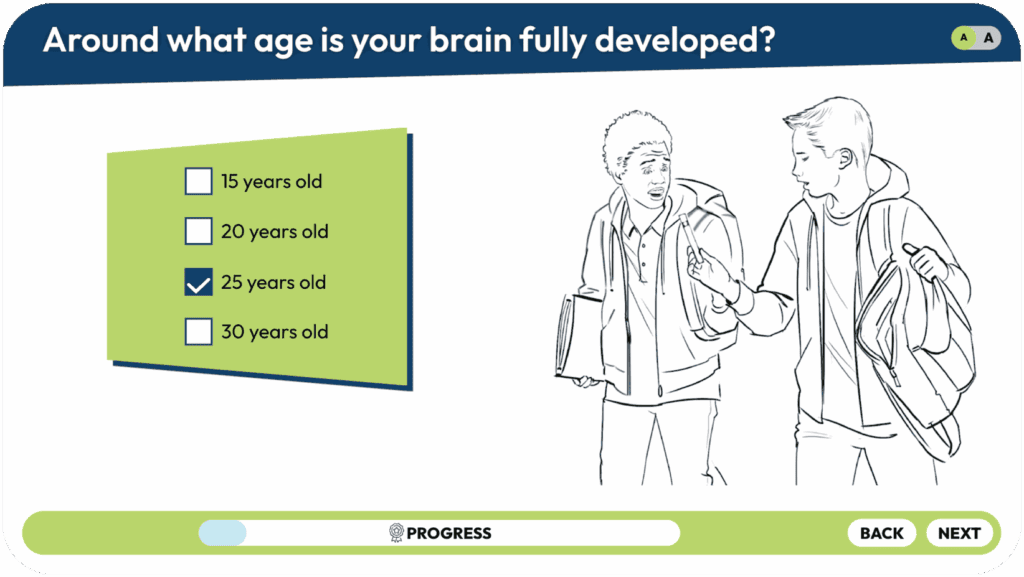
Around what age is your brain fully developed? Show of hands for:
15 years old, 20 years old, 25 years old or 30 years old?
Teacher's Notes
After class votes:
The correct answer is 25 years old. Research shows that the brain is not fully developed until around the age of 25, including areas of the brain responsible for your emotions, memory, and thinking ability.
Since the brain continues to grow until the age of 25, using cannabis before this age can harm the way your brain develops and works.
This is why youth and young adults are especially vulnerable to the effects of cannabis. The earlier you start using the more harm it can do.
Teacher's Notes
What we’re covering today:
What is cannabis, the ways cannabis is used and the associated risks.
Science-based information on the effects of cannabis on your mental health and brain function.
Activities you can pursue that produce similar effects of cannabis but in a healthier way.
Teacher's Notes
You may have heard of cannabis, also referred to as weed, pot and marijuana.
So, what is cannabis? Cannabis is a drug that is often used for its effects on the mind, but it can also be used for medical, social or religious purposes.
Cannabis contains hundreds of chemical substances only found in cannabis.
The two most common chemicals are THC and CBD. THC is the one that makes you feel high and can harm brain development if it’s used daily or near daily.
CBD doesn’t make you feel high but can still have effects on your brain.
Teacher's Notes
Cannabis can be used in different ways. A few of the most common ways are:
Smoking
Vaping
Drinking and eating
Let’s dive deeper into each of these and explore the unique considerations and risks involved.
Teacher's Notes
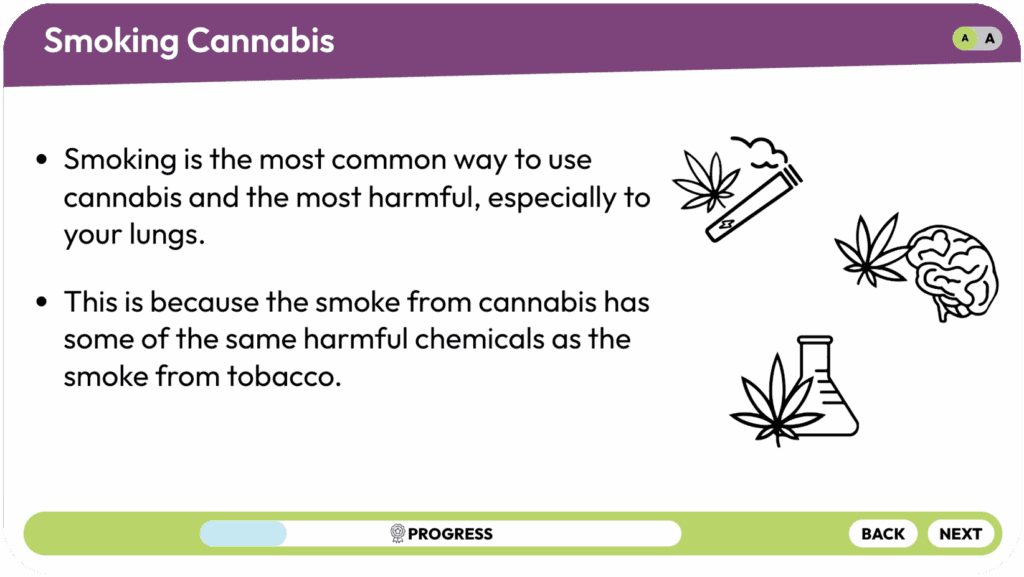
Smoking is the most common way to use cannabis and the most harmful, especially to your lungs. This is because the smoke from cannabis has some of the same harmful chemicals as the smoke from tobacco.
Teacher's Notes
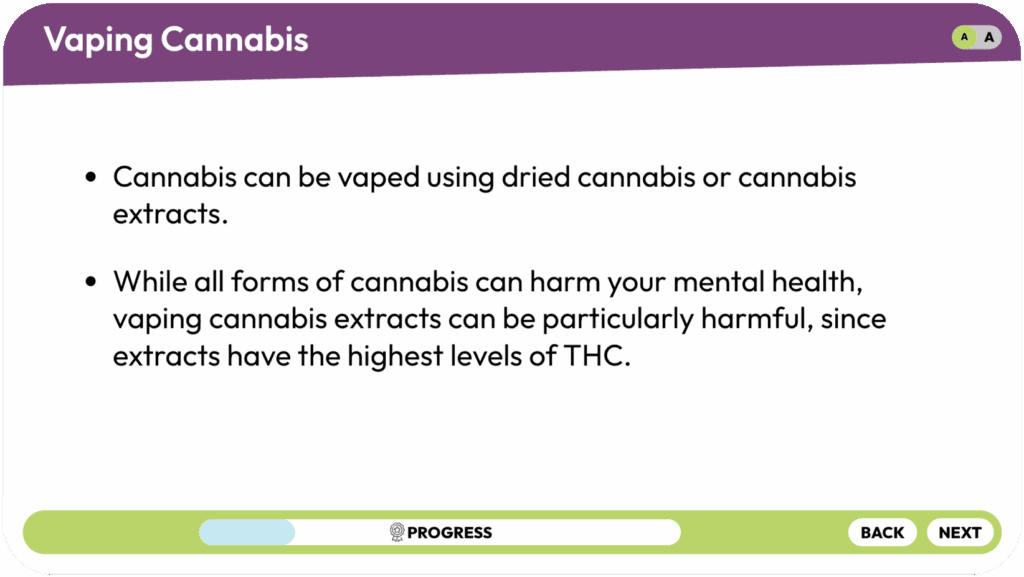
Cannabis can also be vaped using either dried cannabis or cannabis extracts with a vaping device.
Though all forms of cannabis can harm your mental health, especially in the period of life when your brain is developing and therefore more vulnerable, vaping cannabis extracts can be particularly harmful since they have the highest levels of THC.
Vaping cannabis extracts that are high in THC, which is generally any product with a THC content of 10% or more, is considered risky, especially for youth.
Teacher's Notes
Let’s talk about drinking and eating cannabis, also known as edible cannabis.
Edible cannabis comes in many forms such as drinks and baked goods.
The effects from edible cannabis are delayed and can feel particularly strong. This is because THC is broken down in the liver first and made into a stronger form of THC before reaching the brain.
Teacher's Notes
It’s important to know that it can take up to 4 hours to feel the full effects from eating and drinking cannabis. Some effects can even last up to 12 hours. Using more cannabis before the 4-hour mark can result in very strong mental and physical effects that may require urgent medical attention.
Another thing you should be aware of is that some illegal edible cannabis products are made to look like normal products you recognize, like candy, gummies and even chocolate bars.
It can be hard to tell the difference between a regular snack and a product that contains cannabis.
Teacher's Notes
Now let’s discuss the legality surrounding cannabis in Canada.
Teacher's Notes
As of October 17, 2018, Cannabis is legal in Canada.
The Cannabis Act came into effect in October 2017. The legal framework controls the production, distribution, sale and possession of cannabis across Canada.
The reasons for legalization are to accomplish 3 goals:
protect the health of youth by restricting access;
impose serious criminal penalties on people who break the law, especially those who import or export cannabis illegally or provide cannabis to youth;
protect public health and safety by allowing adults access to legal cannabis.
Teacher's Notes
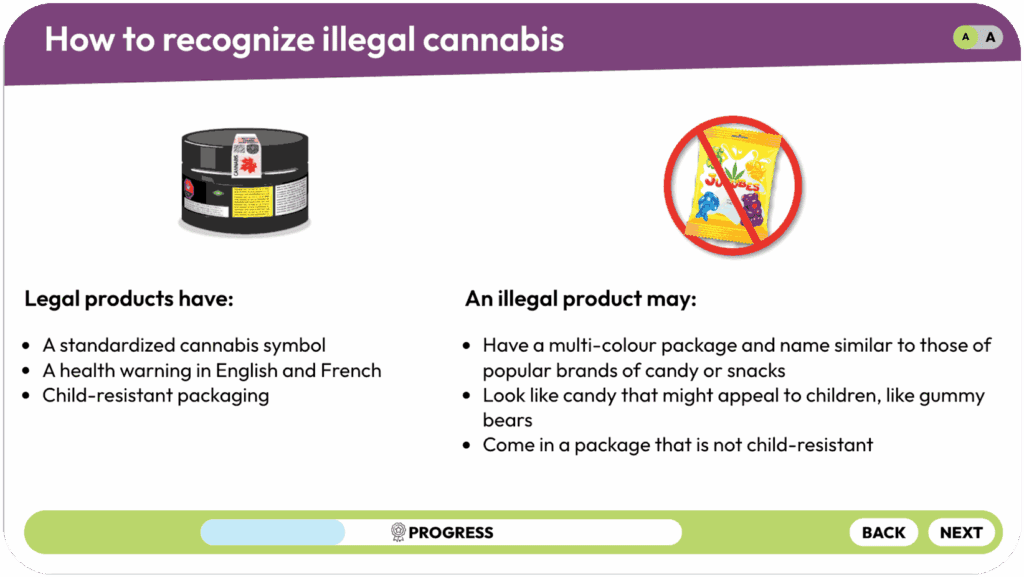
There are some key ways we can tell the difference between legal and illegal products.
The easiest way is the packaging. As you can see from this slide, legal cannabis packaging is plain, does not appeal to youth, has a standardized cannabis symbol and a health warning message.
Illegal cannabis products, like the one shown here, often come in colourful packaging and can sometimes have similar names to a candy or treat we are all familiar with.
Sometimes these products are even designed to look like well-known brands.
Just know that a legal product will never look like a snack you can buy at the grocery store.
It is important to be able to tell the difference between legal and illegal cannabis products because illegal cannabis products come with extra risks.
We will talk more about this on the next slide.
Teacher's Notes
In order to protect youth like you from the risks of cannabis use that we just mentioned, the Cannabis Act, restricts youth access to it. This means that there is no legal way for a young person to get cannabis.
This law is also in place to protect those of legal age from the risks of illegal cannabis. Legal cannabis can only be purchased through stores that have approval from the government. For example, something that is sold by a person instead of a store is illegal. This type of cannabis can be dangerous as it is not quality-controlled or tested. This means that these products may have harmful levels of THC, heavy metals, pesticides and other substances which can cause serious harm when used.
For example, in the US in 2019, an unregulated cutting agent was used in illegal THC-containing vaping products. This was associated with an outbreak of Vaping-Associated Lung Illness that sickened thousands and led to dozens of deaths.
Now, we’re going to talk about how cannabis and brain development are related.
Teacher's Notes
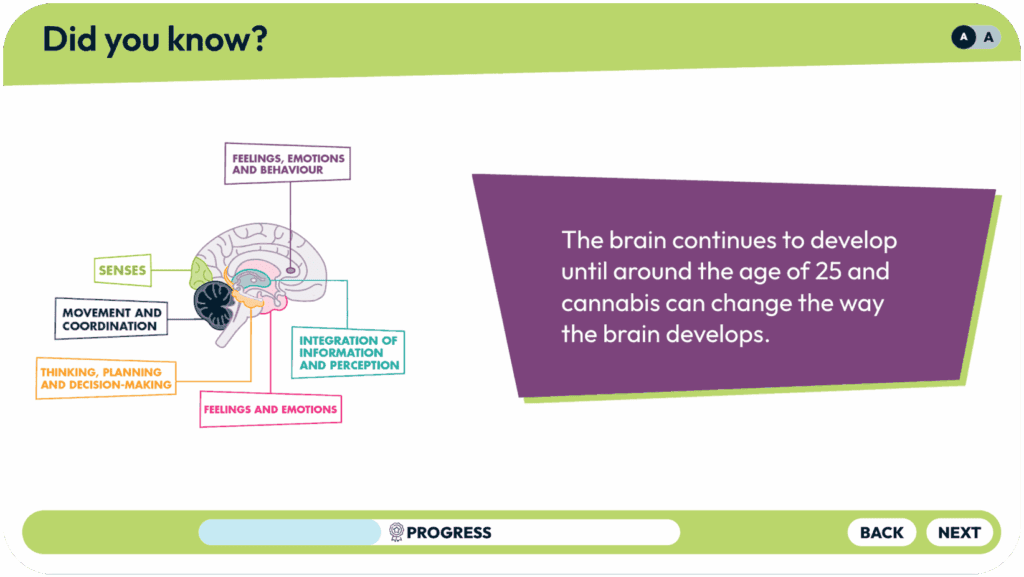
One of the main goals of Pursue Your Passion is to help you become aware of the impacts cannabis has on your mental health and brain function. Because your brain continues to develop until around the age of 25, this means youth are uniquely at risk of the impacts of cannabis.
Cannabis can impact different parts of the brain and can potentially have long-term impacts on your:
senses;
movement and coordination;
thinking, planning and decision-making;
feelings, emotions and behaviour; and
perception.
Let’s learn the facts on how cannabis affects each area of the brain and what could potentially happen long term.
After today’s session you will have access to a 360 Brain tool that we can work through in class to learn more!
Teacher's Notes
Note: this slide featuring the 360 Brain tool is optional to view now, or you may choose to access the tool later.
With the 360 Brain tool, you will be able to access different parts of the brain to learn what they do, and the impact cannabis use can have on each one.
I’m going to show you some of the features of the 360 Brain tool and then you can navigate the brain on your own and come back and show us what you learned!
Optional: show a quick demo of the 360 Brain tool.
Teacher's Notes
Note: this slide featuring the 360 Brain tool is optional to view now, or you may choose to access the tool later.
Great, now it’s your turn! The link is on the screen. Navigate to the 360 Brain and find the part that registers and stores memories. Once you’ve found it, come back here and enter your response.
Teacher's Notes
What part of the brain registers and stores memories?
Is it the Frontal Lobe, Prefrontal Cortex, Corpus Callosum, or Hippocampus?
Teacher's Notes
After class answers:
The correct answer is Hippocampus. The compounds in cannabis, such as THC, bind to brain receptors or cannabinoid receptors located in the hippocampus. This can harm your memory and make it more difficult to learn and to make decisions.
After today’s session you will have access to the 360 Brain tool to learn more!
Teacher's Notes
It’s important to remember that youth and young adults who consume cannabis, especially cannabis containing THC, are more likely to experience mental health problems. This happens because cannabis can interfere with healthy brain development until around the age of 25.
Teacher's Notes
A medical professional talks about the risks associated with cannabis use.
When ready, press the play button to start a short video.
Teacher's Notes
Now, let’s dive into some of the effects cannabis can have on you.
Teacher's Notes
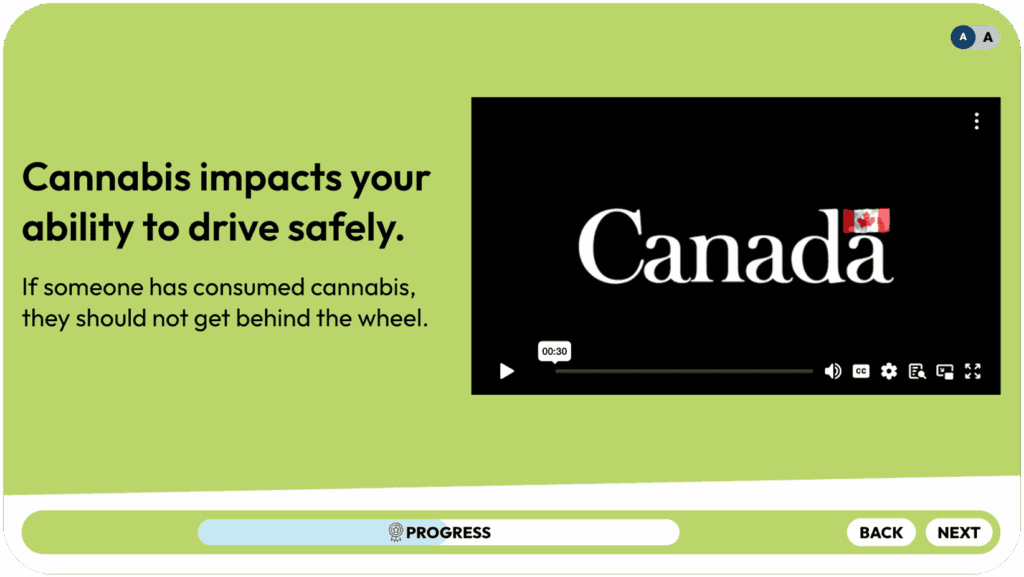
We’re going to watch a quick video about how cannabis impacts your ability to drive safely.
Play video.
Some people think it’s ok to drive after using cannabis because it helps them focus or makes them a ‘better driver’ or they think they can’t get caught.
We just learned about the broad range of effects that can be experienced after using cannabis. Because of these effects, it’s irresponsible and unsafe to drive after cannabis use. That’s why it’s against the law.
Science has shown that cannabis can impair a person’s ability to drive because it reduces the ability to react quickly, interferes with attention and impairs coordination. These skills are essential for driving safely and police have greater tools now than ever to detect cannabis impaired driving.
If you know someone who has used cannabis and plans to drive, don’t get in a car with them. Instead, please consider a safer way to get yourself home. Call an Uber, Lyft, taxi or ask someone you trust to come pick you up.
Teacher's Notes
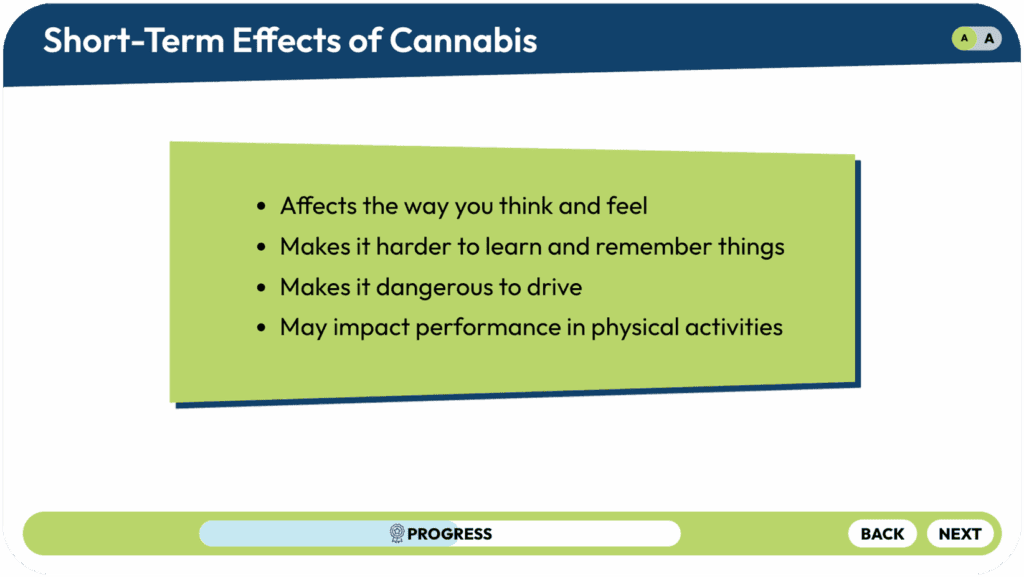
These are the short-term effects of cannabis:
Affects mood and feelings. While cannabis can make you feel relaxed and happy at times, it can also make you feel uncomfortable, including feeling anxious, paranoid and depressed.
Makes it harder to learn and remember things. As using it, you may have problems paying attention and making decisions. Using cannabis can reduce your ability to perform well at work or school.
Makes it dangerous to drive safely. Driving is a complex task and requires the use of many areas of the brain. Cannabis can decrease the ability to react quickly, interfere with attention and impair coordination.
May impact your ability to perform at your best while participating in sports and other physical activities that require coordination, a quick reaction time and balance.
Teacher's Notes
Though some people use cannabis to relieve symptoms of anxiety and depression, scientific evidence suggests that using cannabis on a daily or near daily basis does not improve these symptoms over time and can instead worsen mental health issues. The reason is because cannabis interferes with healthy brain development, including the amygdala, which is part of the brain that controls emotions.
Teacher's Notes
The likelihood of experiencing these mental health issues is greatest in those who do the following:
Start using cannabis earlier in age, especially before the age of 16.
Use cannabis daily (or near daily) over a long period of time, for weeks or months.
Use cannabis products containing 10% or more THC.
Have a family history of mental health disorders, such as psychosis or schizophrenia.
Teacher's Notes
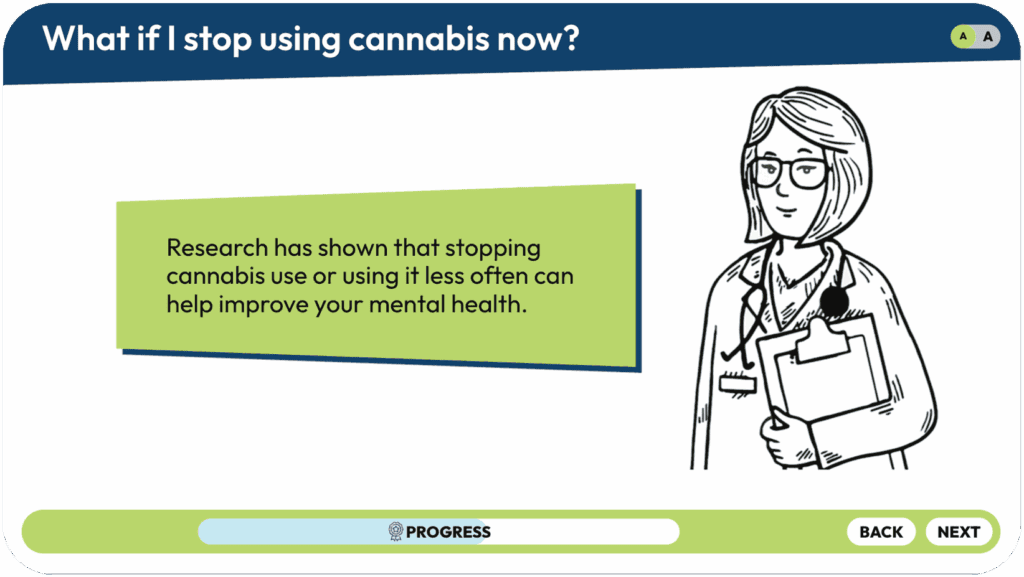
Evidence has shown that reducing or stopping cannabis use can help improve your mental health.
Teacher's Notes
Contrary to popular belief, people can become addicted to cannabis. Daily or near daily cannabis use can cause physical dependency and addiction. This can negatively impact your mental health and other areas of your life like school and relationships.
Addiction can start at any age, but youth are especially at risk because their brains are still developing.
It’s important to remember that people don’t choose to have an addiction, and it can be very hard to stop using cannabis when you have this condition.
But people can get better with the right help.
Teacher's Notes
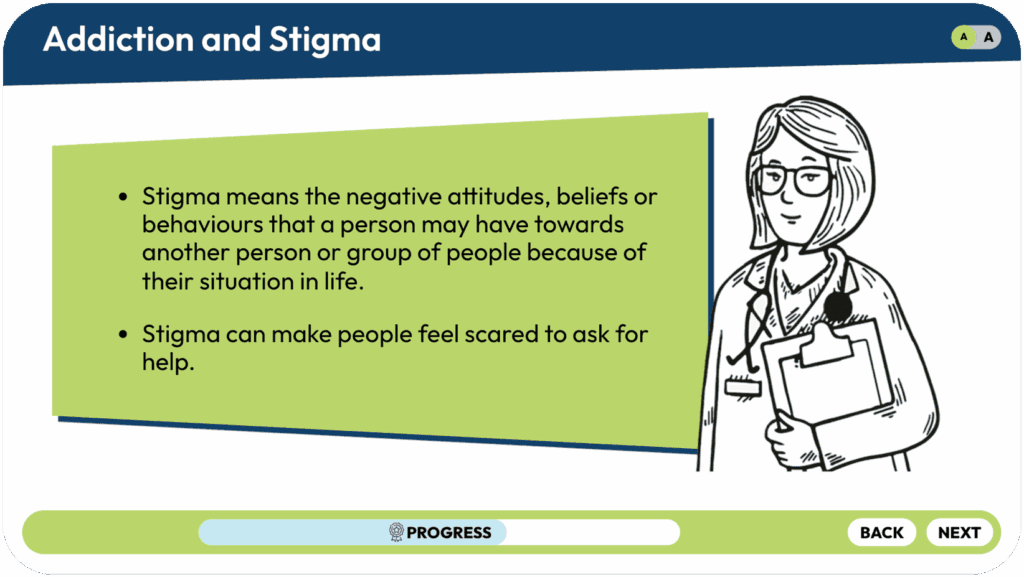
Stigma means the negative attitudes, beliefs or behaviours that a person may have towards another person or group of people because of their situation in life. Someone who is stigmatizing may treat someone unfairly based on this negative belief.
People use drugs or alcohol for many reasons, but no one chooses to develop an addiction. Addiction makes it hard to stop using drugs, even when it’s hurting you or people in your life. But the problem is that some people don’t realize this and they blame the person, thinking they can just stop if they wanted to.
Stigma around addiction is harmful because it can make a person feel lonely and make it harder for them to get help.
That’s why it’s important to always treat everyone nicely and with respect, no matter what their situation is.
Teacher's Notes
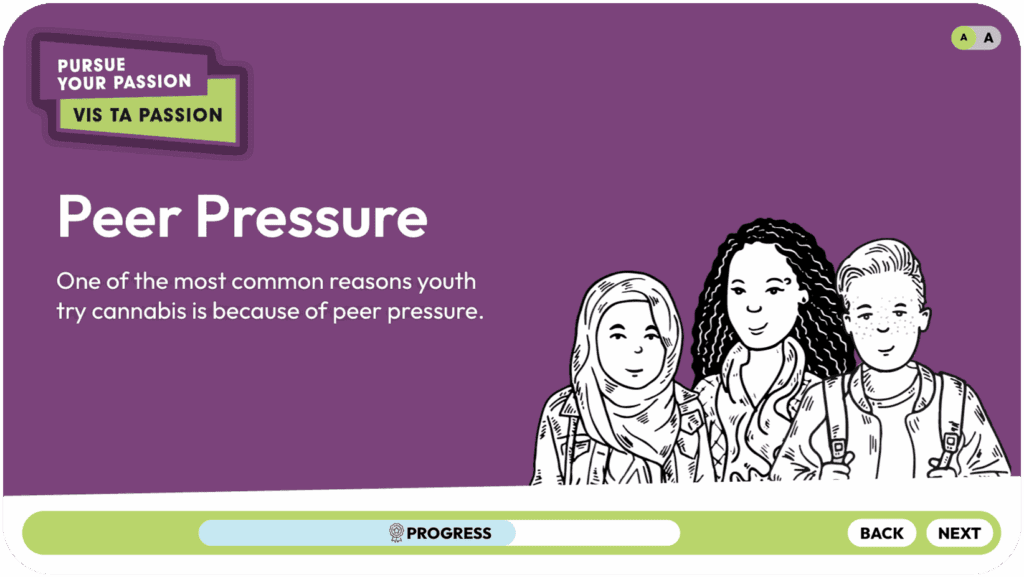
Peer pressure is when your peers (these could be your friends, classmates or teammates) encourage you to do something and you feel like you have to do it to fit in.
It’s normal to want to fit in and do the same things as your peers, but it’s important that your choices feel right for you, too. One of the most common reasons youth try cannabis is because of peer pressure.
Thinking about peer pressure ahead of time can help you be ready to respond and do what’s right for you.
Here are some ways to handle peer pressure:
Say ‘no thanks’ or ‘I’m not interested.’
Pay attention to how you feel. If something doesn’t feel right about a situation, it probably isn’t. Even if your friends seem ok with what is going on, the situation may not be right for you.
Use a previous commitment as an excuse, something like ‘I’m late for practice’ or ‘I have to get home to do my chores.’
Blame – Make it about your parents. You could say ‘I’d be in so much trouble, it’s not worth it,’ or ‘I’m grounded and have to go home’ or ‘I told my mom I would help her clean the house.’
Your friends should respect your choices and never pressure you, especially when it comes to things that can harm you. Remember that dealing with peer pressure can be tough.
Teacher's Notes
Chapter Three: Pursuing Your Passions & Resources
Teacher's Notes
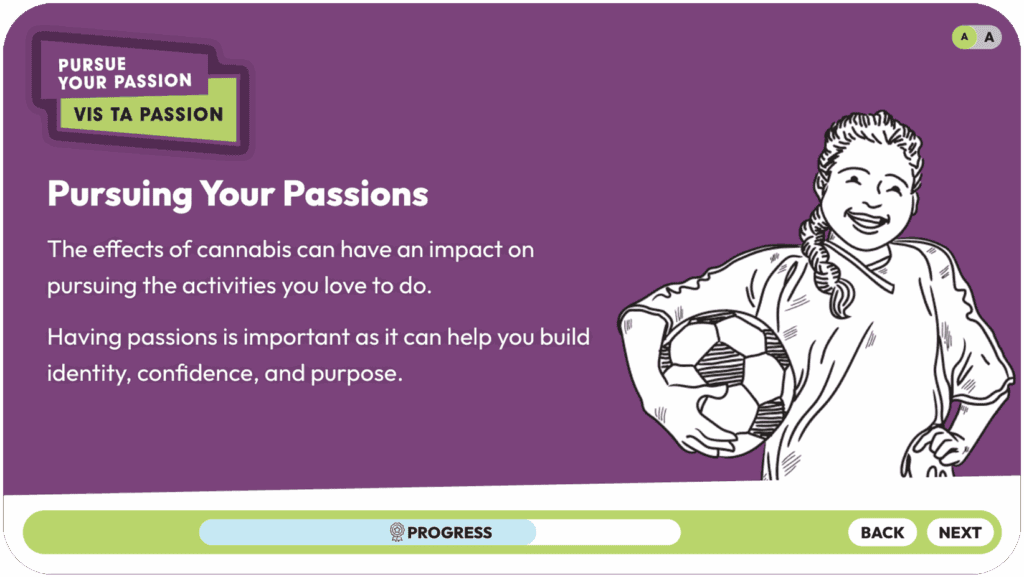
With everything you just learned about the effects of cannabis, you understand that it can have an impact on pursuing the activities, or passions, you love.
What is a passion? A passion is an activity, hobby or skill that you enjoy doing frequently because it makes you happy.
Having passions is important as it can help you build identity, confidence and purpose.
Passions are different for everyone.
Some ways to find out what you are passionate about is to try many different activities like sports, music, creating art, learning from others and building new skills.
Teacher's Notes
How many of you enjoy physical activities?
Physical activities require a diverse range of core functions such as coordination, reaction time and balance. Cannabis can affect these core functions, meaning your ability to enjoy the activities you love can be impacted.
Did you know that exercise can help alleviate feelings of anxiety and depression, and even help prevent mental health disorders from ever developing?
Teacher's Notes
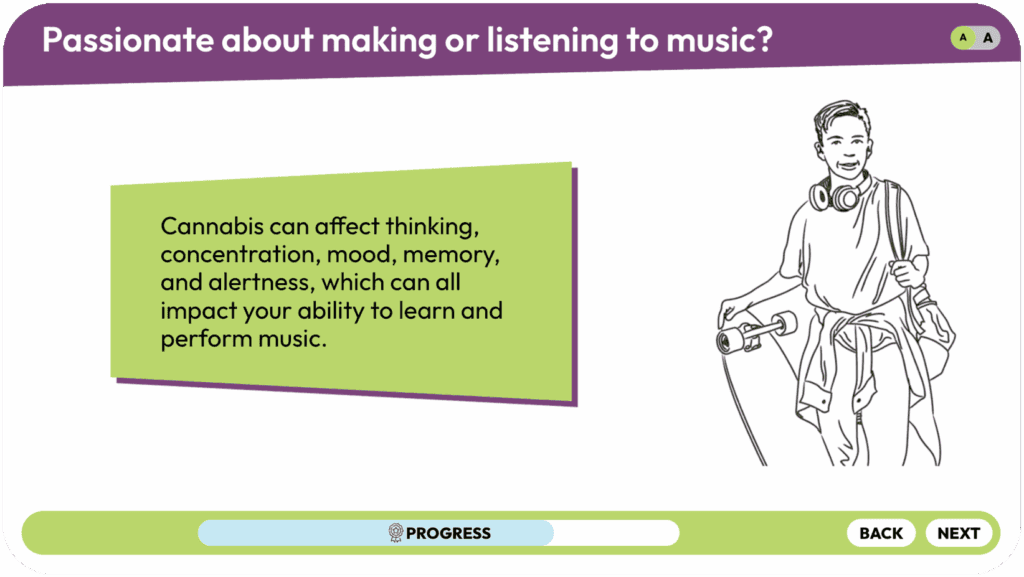
How many of you are passionate about making or listening to music? Raise your hand.
Amazing. Well, cannabis can affect your thinking, concentration, mood, memory and alertness, which can all impact your ability to learn and perform music.
Producing and listening to music triggers the release of the ‘feel-good’ chemical dopamine and decreases the stress-causing hormone, cortisol.
Teacher's Notes
Who wants to share their favourite style of music?
Raise your hand.
Take a moment for students to answer and ask a follow up question:
Name your favourite style of music.
How do you feel when you hear it?
Teacher's Notes
How many of you are passionate about making or looking at art?
Some people turn to cannabis to relieve stress. Viewing and creating art can also make you feel happy and decrease stress.
Similar to making or listening to music, this is because viewing and creating art triggers the release of the ‘feel-good’ chemical, dopamine, and decreases the stress-related hormone, cortisol.
Teacher's Notes
Who can tell me the correct answer to this question: When you engage in a creative activity, which ‘feel-good’ chemical is released? Is it:
Cortisol, Dopamine, Hippocampus, or the Frontal Lobe?
Teacher's Notes
After class votes:
The answer is…dopamine!
Dopamine is an important brain chemical that makes you feel happy. It also affects how you learn and focus.
Teacher's Notes
So, let’s Pursue Your Passion!
Teacher's Notes
Today we are going to focus on a creative challenge!
We will have 2 minutes to complete this challenge.
Pick something to draw and get creative on paper.
I’m going to set up the 2-minute timer.
After 1 minute:
1 minute left!
After 2 minutes:
Time’s up! How do you feel?
Teacher's Notes
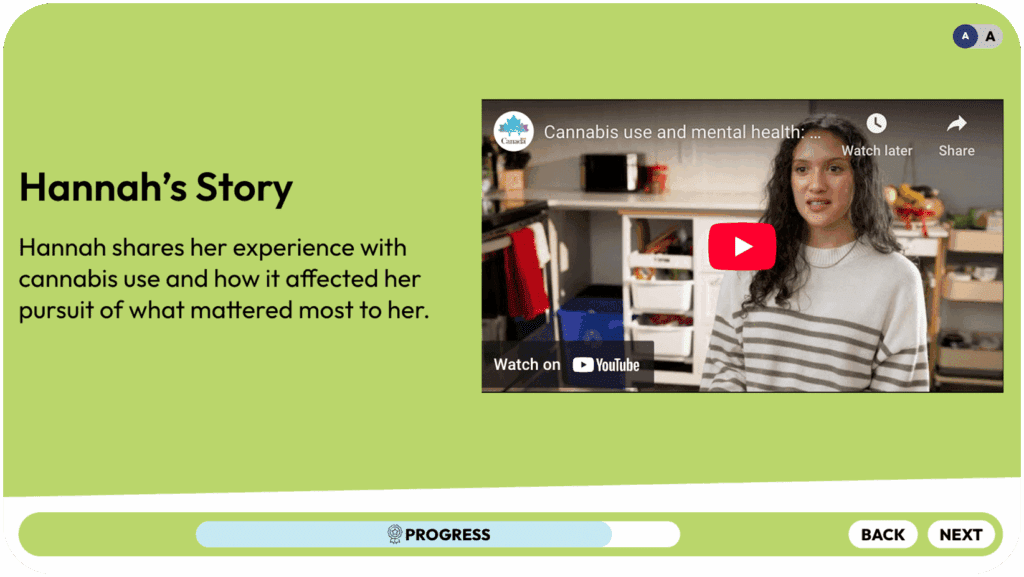
Hannah shares her story about cannabis use.
When ready, press the play button to start a short video.
Teacher's Notes
Remember… daily (or near daily) and long-term cannabis use can have a significant impact on brain development, as well as on mental and physical health. The best way to protect your health is to not use cannabis.
Participating in physical activity, music, art and other activities that you’re passionate about, can activate some of the same areas of the brain as cannabis, especially when trying to relieve stress or anxiety.
Teacher's Notes
Finally, after today, what can you do to increase your cannabis awareness?
Teacher's Notes
After class vote:
These are all great options for you to increase your awareness.
Teacher's Notes
We have talked about a lot today so before we finish up does anyone have any questions?
Leave a moment for students to share their thoughts.
What’s your biggest takeaway? Did anything surprise you?
Teacher's Notes
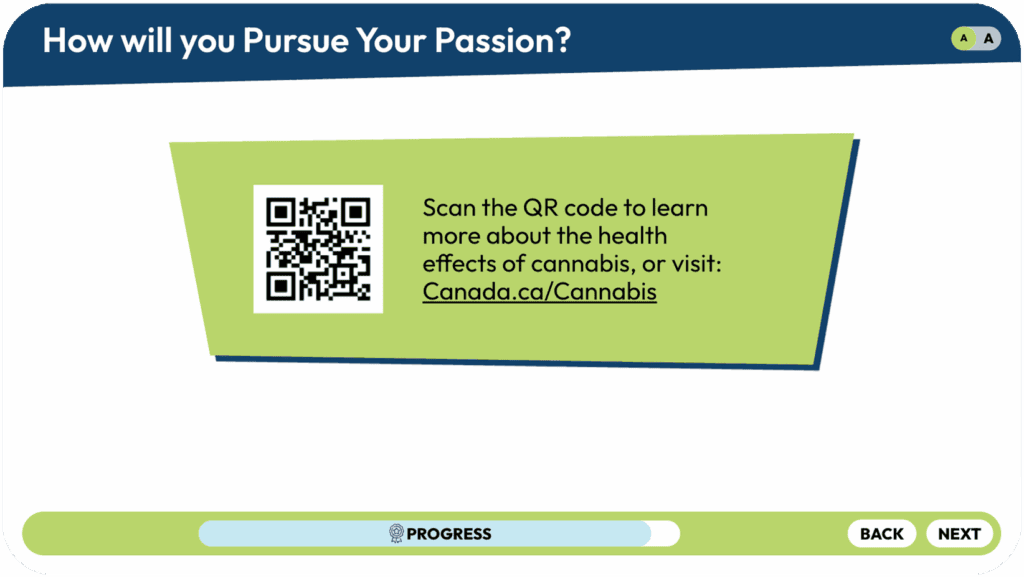
How will you Pursue Your Passion?
Scan the QR code to learn more about the health effects of cannabis, or visit Canada.ca/Cannabis.
Teacher's Notes
Talking about substances and mental health can bring up strong feelings.
If you or someone you know is struggling with, or has questions about, substance use and/or mental health, the Kids Help Phone is there.
This service offers 24/7 bilingual and confidential support by phone and text, as well as live, virtual chat in the evenings for anyone up to 20 years old.
Teacher's Notes
Thank you for participating in Health Canada’s Pursue Your Passion teacher-led module.